Blog 3 min read
AI is creating a database explosion. Who is going to keep these databases running?
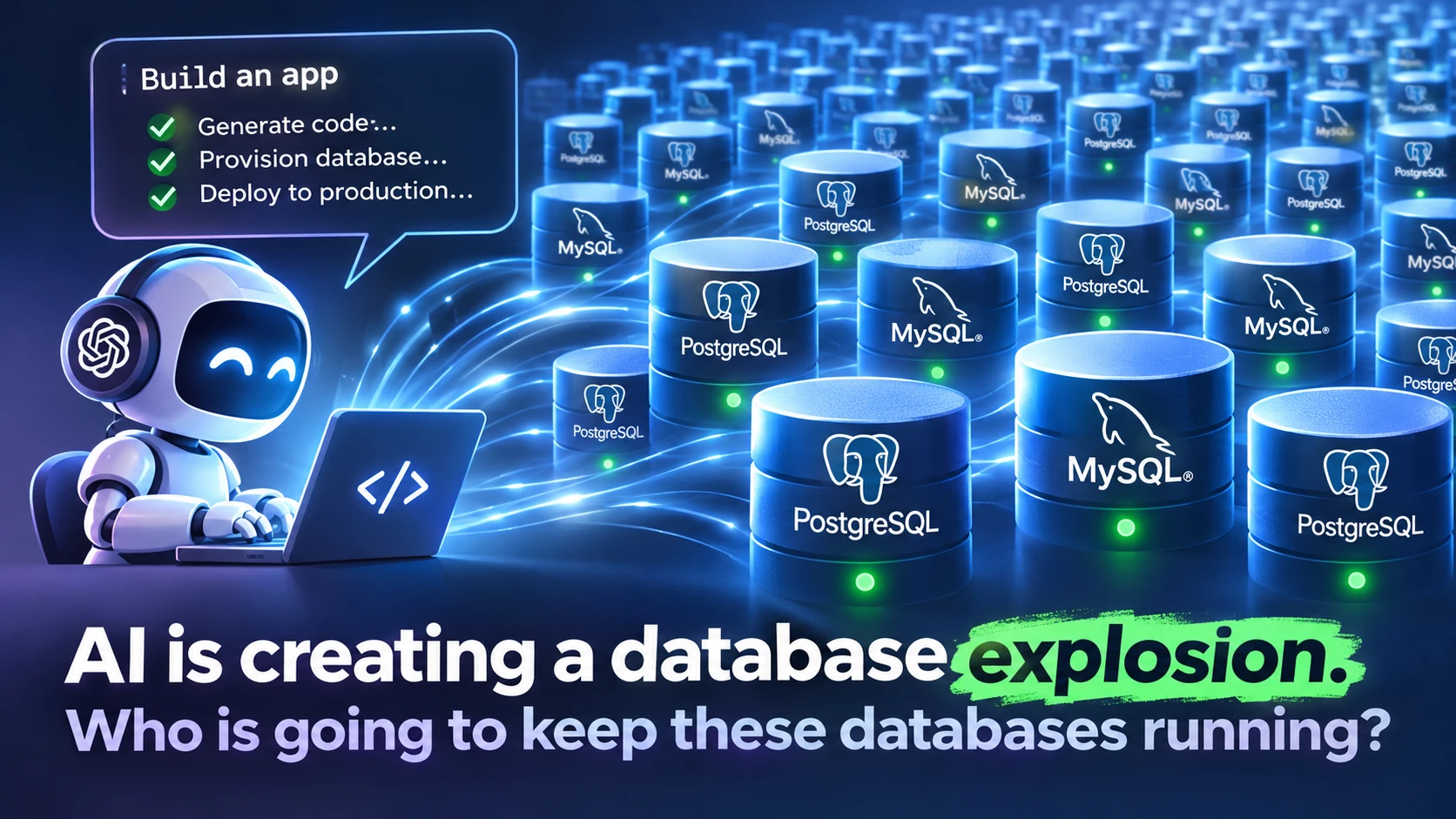
The rise of autonomous software development is fundamentally changing the database market. Coding agents have compressed the time between conceiving an application and deploying it into production from weeks to hours, and behind almost every one of those applications sits a database that somebody has to keep running.
Over the past two years, large language models (LLMs) and coding agents have dramatically compressed the time between conceiving an application and deploying it into production. An application that once required weeks of development can now, in some cases, be created in hours.
But behind almost every substantial business application sits a database. And increasingly, that database is PostgreSQL or MySQL.
The rise of the AI-provisioned database#
When developers instruct a Super Intelligence coding agent to build an application, the agent will frequently select PostgreSQL or MySQL without being explicitly told to do so.
The reasons are straightforward. Both databases are open source, extensively documented and easily provisioned inside containers. An autonomous coding agent can deploy a database alongside the application, create schemas, populate test data, execute integration tests and resolve development problems without human intervention.
Database provisioning has effectively become part of application development.
The 2026 Stack Overflow Developer Survey, which collected database usage information from over 12,000 respondents, illustrates the growing importance of these technologies:
- PostgreSQL: 57.9%
- MySQL: 35.1%
- Microsoft SQL Server: 27.1%
- MongoDB: 19.0%
- Oracle Database: 9.4%
While these figures reflect developer usage rather than production deployments, they demonstrate the dominant position of open-source relational databases among today’s developers.
As autonomous software development accelerates, we expect this trend to intensify considerably.
The operational problem nobody is talking about#
Creating a database and operating one reliably in production are two fundamentally different disciplines.
Historically, commercial database vendors invested heavily in sophisticated diagnostic, performance analysis and troubleshooting capabilities. The open-source database ecosystem evolved differently, leaving much of this responsibility to database administrators, community tools and third-party providers.
Although monitoring solutions exist, many remain fragmented, expensive, overly complex or dependent on specialized database administration knowledge.
Traditional monitoring frequently tells you that something is wrong without adequately explaining why.
A CPU utilization spike, increasing query latency or declining cache efficiency is a symptom, not a diagnosis. Developers need to understand what is actually happening inside their databases, how the internal subsystems interact and where performance bottlenecks originate.
This becomes particularly important when applications are developed by AI agents and deployed by individuals with limited database administration experience.
DBFrog: making databases understandable#
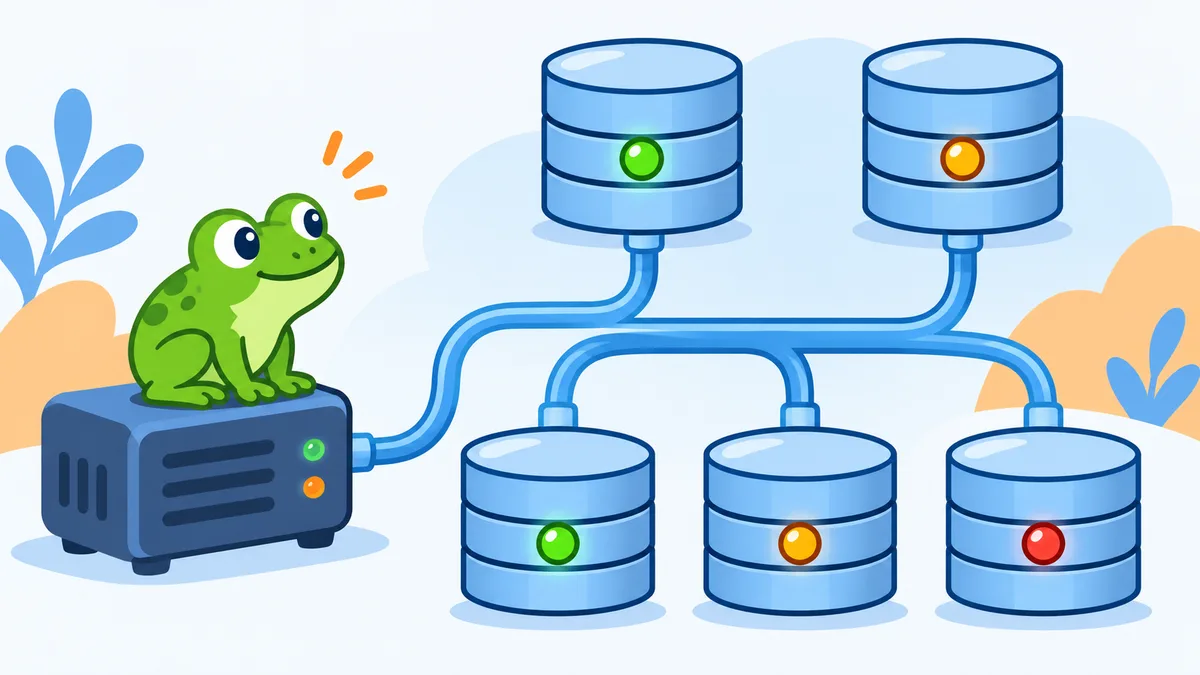
At Opvizor, we developed DBFrog to address precisely this challenge.
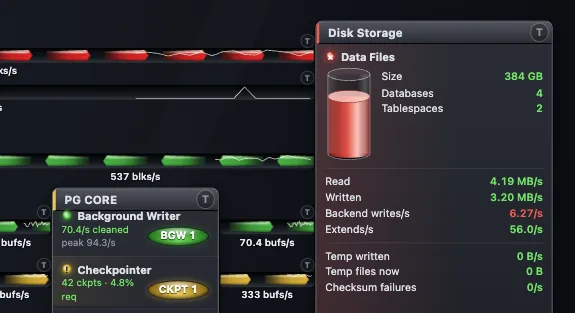
Rather than presenting users with dozens of disconnected performance graphs, DBFrog visualizes the internal workings of the database engine on a single screen. Developers and administrators can see how connections, query execution, memory buffers, transaction logs, replication and disk activity interact in real time.
Performance problems are visually highlighted where they occur. Users can investigate individual SQL statements, blocking locks, resource contention and other underlying issues.
DBFrog goes beyond monitoring by providing:
- Real-time visualization: understand database internals and identify bottlenecks as they develop.
- AI-driven problem solving: receive actionable performance and security recommendations, including specific SQL statements and configuration changes where appropriate.
- Historical replay: reconstruct past database incidents and investigate what happened.
- Deep diagnostics: examine individual queries, sessions, locking conflicts and resource utilization.
- Rapid deployment: start monitoring within minutes, without constructing dashboards or deploying database-side agents.
DBFrog supports PostgreSQL, MySQL, MongoDB, Microsoft SQL Server and Redis, both on-premises and in the cloud.
Democratizing database operations#
Super Intelligence is democratizing application development. Database monitoring and troubleshooting need to undergo a similar transformation.
Organizations should not require expensive enterprise monitoring platforms or dedicated database specialists for every newly deployed application.
At just $4 per database instance per month, DBFrog makes sophisticated database diagnostics accessible to individual developers, startups and large enterprises alike.
The next wave of software development will create an enormous number of new databases. The challenge will no longer be how quickly organizations can deploy them, but how effectively they can understand, optimize and operate them.
With DBFrog, the objective is simple: see what your database is doing, understand why it is experiencing problems, and know what to do about them.
See DBFrog in action, explore the interactive demo or start your free trial at opvizor.com/dbfrog.