PostgreSQL 19 shipped this week, and its main theme is control over table maintenance and query plans. A Percona guide to MongoDB upgrades shows how much a single version change can hide.
The chart#
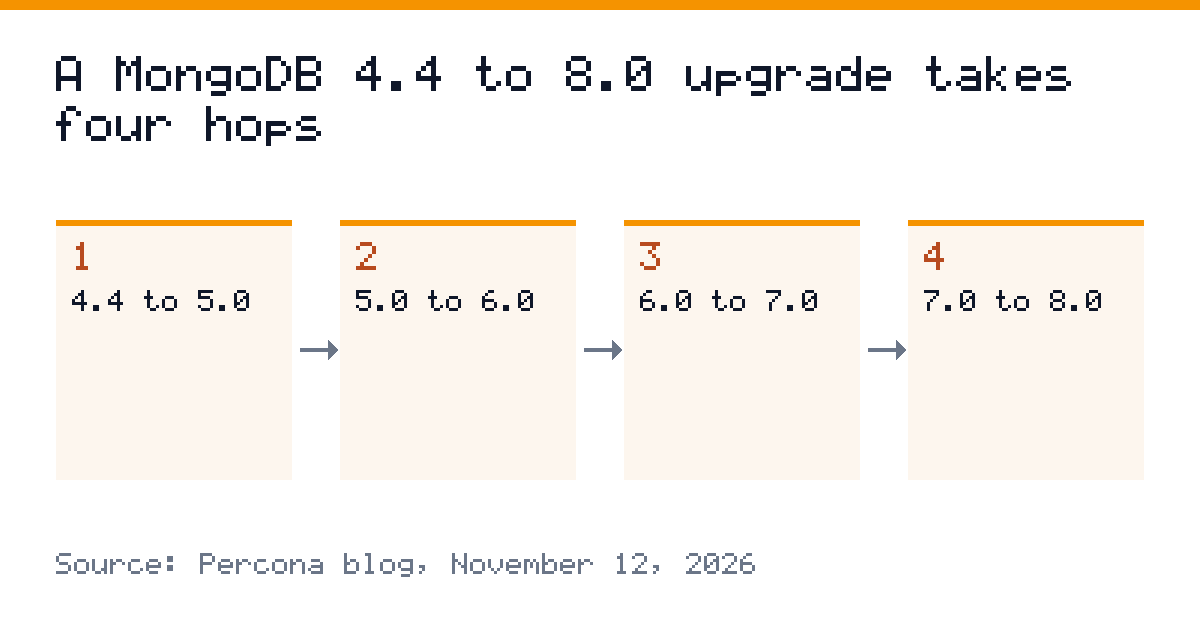
A MongoDB 4.4 to 8.0 upgrade takes four hops#
MongoDB upgrades one major version at a time. Each hop has its own upgrade page, compatibility notes and rollback rules. The featureCompatibilityVersion setting must point at the previous version before the next hop works, and raising it rules out a binary downgrade. Plan four separate rounds of checks.
This week#
PostgreSQL 19 adds online REPACK and plan advice#
PostgreSQL 19 came out on November 19, 2026. The new REPACK command reclaims disk space and reorganizes table contents. With CONCURRENTLY, it runs without blocking reads and writes. The pg_plan_advice extension lets you steer planner decisions, and pg_stash_advice applies that advice by query. Standbys get read-your-writes consistency through a new WAIT command. Upgrades need pg_upgrade or dump and restore. postgresql.org
Databricks offers PostgreSQL 19 on Lakebase on day one#
Databricks said PostgreSQL 19 was available on its Lakebase service the same day the community released it. Author Savannah Longoria wrote that new major versions often take weeks to reach other managed services. The post calls 19 a practical release about operational control: REPACK, query plan advice and WAIT FOR LSN for read-your-writes on replicas. Teams pick 19 when creating a project. databricks.com
Why MongoDB upgrades stall halfway#
Percona’s Zelmar Michelini describes why MongoDB upgrades stall. MongoDB moves one major version at a time, so 4.4 to 8.0 takes four hops, each with its own notes and rollback rules. Common traps are featureCompatibilityVersion, held packages, old drivers that send legacy opcodes and backup agents that fall behind. Raising FCV blocks a binary downgrade. Check each one before every hop. percona.com
gopgext builds PostgreSQL extensions from Go code#
gopgext is an experimental tool that builds PostgreSQL extensions from plain Go code using TinyGo. Mark a function with a comment tag and it becomes a SQL function, with the C glue, install script and control file generated. It also covers triggers, aggregates and index access methods. It warns against production use because bugs run inside the server. jespino.github.io
From our blog#
Meet DBFrog: one binary that watches five database engines#
A team that runs several database engines has to watch each one. The engines expose different numbers, and a failure still needs one place to look. Opvizor’s post introduces DBFrog as that place. It is one binary that monitors PostgreSQL, MySQL, MongoDB, Microsoft SQL Server and Redis, in the cloud or on premise.
You run it on a Linux host, open it in the browser and add an instance with a host, port and monitoring user. No schema changes and no agents are needed. The live view draws the database as clients, backends, buffers, WAL and disk, with green, amber and red status on each panel. It reads the monitored database read-only and never runs suggested fixes itself.
It also scans configuration, versions, security and workload, and explains each finding in plain language with a next step. History can be replayed to any chosen time, so a post-mortem starts with evidence. Findings are graded Critical, Warning or Info. Insights are re-checked every five minutes.
DBFrog watches PostgreSQL, MySQL, MongoDB, SQL Server and Redis in one panel, and its replayable history lets a post-mortem start from evidence.
P.S. minipg packs a whole PostgreSQL into a browser demo. New databases there come from a template cluster made at build time, because initdb takes half a minute on v86. progrium.github.io