VMware came back to small server virtualization, and a cloud architect built a replacement for a migration library VMware pulled. Both stories show how much of your infrastructure depends on vendor decisions you do not control.
The chart#
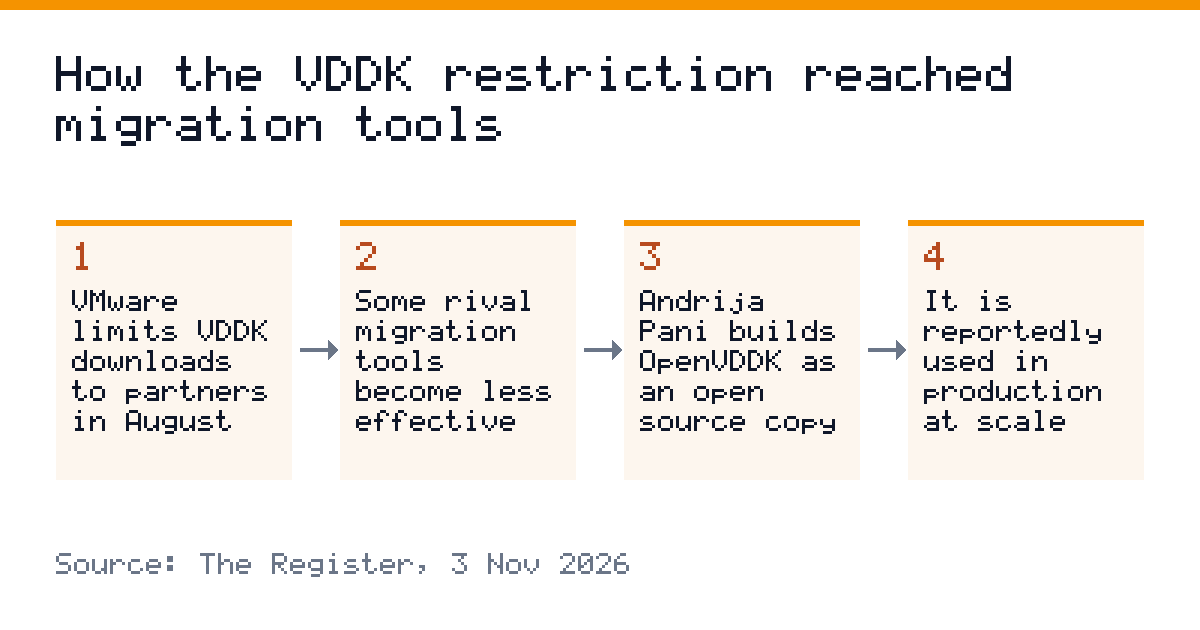
How the VDDK restriction reached migration tools#
Read the steps from top to bottom. A single library, VDDK, sits under many migration tools, including virt-v2v, nbdkit, Forklift, Proxmox VE and Apache CloudStack. When access closed, one architect rebuilt it openly. Check which of your tools depend on it.
This week#
VMware brings back a small vSphere edition#
VMware has brought back a small server virtualization product called vSphere Express. It runs on up to 128 cores and includes vMotion live migration, automatic restart of failed VMs and a distributed switch. Each instance stands alone, with no central management. Broadcom’s Prashanth Shenoy says it is tested for small setups, not thousands of cores. The Register reported the launch. theregister.com
OpenVDDK fills the gap VMware left#
VMware withdrew its Virtual Disk Development Kit, a toolkit for backup and storage developers, from public downloads. In August it limited access to partners. Many migration tools use that library to read VM disks, so some became less effective. Cloud architect Andrija Panić has built OpenVDDK, an open source replacement. It is reportedly already used in production at scale. theregister.com
Can an LLM build a Raft message broker from a spec?#
A founder building an AI integration lab tested whether an LLM can build a correct distributed system from a spec alone. The model got the AMQP 0.9.1 specification, a Raft clustering requirement and support for up to 9 nodes. The outcome is a message broker called Switchboard, published with the full session history and tool outputs. Its author will maintain it. github.com
From our blog#
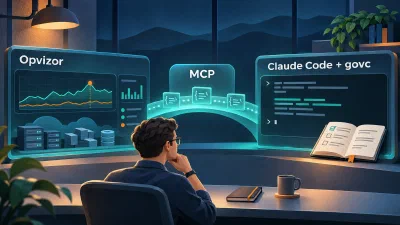
From Alert to Answer: Combining Opvizor, MCP and Claude Code#
An alert tells you that something is wrong. It rarely tells you why. The admin who gets paged then opens a dashboard, then the logs, then the change history, then the vendor documentation. Each step is manual, and the answer often sits in a different tool from the alert.
The Opvizor blog looks at closing that gap with MCP, the protocol that lets an AI agent call outside tools. Opvizor already holds the pieces an investigation needs: performance dashboards for ESXi hosts and VMs, log analysis through Syslog, and a record of changes made to each VM. Exposed through an MCP server, those become something a coding agent such as Claude Code can query directly.
The post describes the result as a path from the alert to an answer. The agent starts from the alert, asks Opvizor for the relevant metrics and recent changes, and reports what it found. The admin still decides what to do. The difference is that the first round of digging happens before a person opens a single dashboard.
This builds on earlier posts on the same blog about MCP and VMware agents, including why MCP suits these agents better than raw command line tools.
Opvizor monitors VMware ESXi, Proxmox and KVM, and its AI assistant can be integrated with ChatGPT, Claude Desktop and more.
P.S. The author of Switchboard calls the project a love letter to his former VMware and Pivotal coworkers who worked on RabbitMQ. He says it is not meant to compete with RabbitMQ. github.com